|
|
| |
|
|
|
| |
6.66.011.001 |
|
All Geomet Levels |
| |
|
|
|
|
|
Command Activation
| x |
Measure→Ellipse |
 |
| Keyboard |
Main Menu |
Toolbar |
Definition
The Ellipse feature determines the center location, Major Axis Rotation
and the Minor and Major diameter or radius of inside and outside ellipses projected into a PCS
base plane. The ellipse feature will give erroneous
results when not parallel to a PCS base plane. The ellipse center location
is projected into a PCS base planes and are 2D in nature.
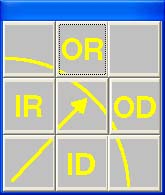
To measure
an Ellipse, press the Ellipse key < x > for the default
number of data points as set in System Options. Geomet will then prompt you for the type
of feature being measured, see figure at left. If you have
Auto Direction enabled, this
prompt will not appear.
The default minimum number of points for an ellipse is 5, however we
suggest using a minimum of 16 when attempting to obtain a form value.

|
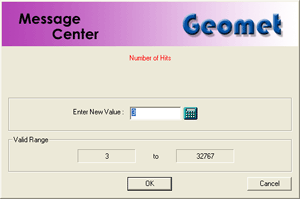
If you required additional data points, you can repeatedly press the
Ellipse key
which increments the required number by one, or press < shift +
X > and you
will be prompted to enter the required number.
 |
|
figure 2, Enter Data Point Count |
 |
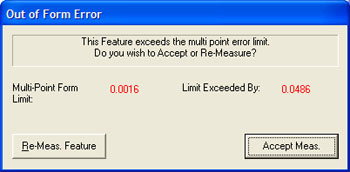
| figure 3, Out-of-Form Warning |
Geomet performs a form validation on your captured data points. This function is called
the Multi-Point Error Limit and is controlled by a setting in System Options. In the event
your ellipse exceeds this limit, Geomet will prompt you whether to accept or re-measure the
feature, see figure 3. If you elect < Re-Measure >, you will be prompted to
capture new data points for the same feature. Note: The Multi-Point Error Limit test
is only performed in the self-teach mode, not during a part program run.
|
|
Tolerance
Tolerance of Ellipses is available in Cartesian or
RFS Positional Tolerance formats.
Ellipses can also be used in the establishment of the Origin in building
a PCS, and all 2D feature constructions.
Related Procedures:
Auto-Direction,
Origin,
System Options, ,
Introduction to Tolerance,
Tolerance Ellipse,
Motion Edit,
Disable Motion,
Projection Errors,
Measuring with Multiple Styli,
Datum Bonus Tolerance Tutorial
|
| |
|
|